Understanding the real causes behind waterproofing failures – and why most problems start before tiles are even installed.
Waterproofing is the most critical layer in any bathroom – and also the most commonly misunderstood. When it fails, the damage is rarely visible until it’s already expensive.
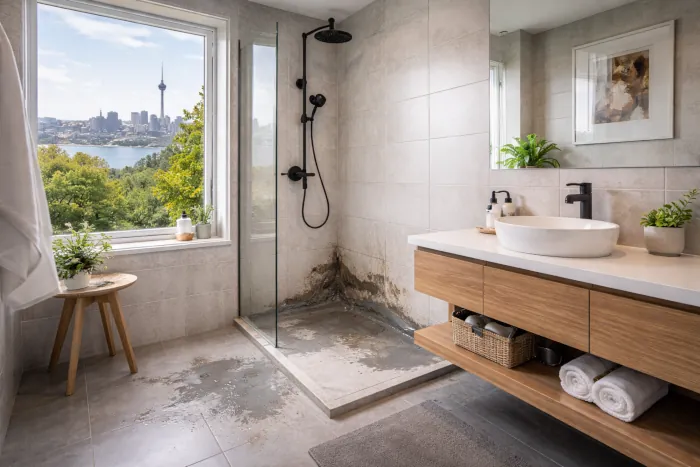
In New Zealand, bathroom waterproofing failures are one of the leading causes of hidden moisture damage in residential properties. What appears as cracked grout or loose tiles is often just the surface symptom of a deeper issue: water has already penetrated the structure.
Industry research consistently shows that most waterproofing failures are not caused by material age but by installation errors, poor surface preparation, and system design issues, as explained in common waterproofing failures in concrete, where it is noted that failures are typically linked to application quality rather than the materials themselves.
1. The Core Issue – Why Waterproofing Fails
Waterproofing systems are designed to last decades. But in reality, many fail within the first 5 – 10 years – not because the materials are poor, but because the system was compromised from the start.
Waterproofing doesn’t degrade evenly – it fails at weak points first, and once it does, damage spreads quickly behind the tiles.
2. Installation – The Biggest Cause of Failure
The single biggest reason waterproofing fails in New Zealand is poor installation.
Industry research shows that improper installation and poor workmanship are among the leading causes of waterproofing failure, including issues such as inadequate surface preparation, incorrect application, and insufficient detailing, as explained in this analysis of top reasons for waterproofing failures.
- No primer – weak adhesion to substrate
- Too few coats – insufficient waterproof barrier
- Rushed curing – membrane weakens before tiling
- Poor detailing – corners and joints fail first
Even small shortcuts during installation can turn a 20-year system into a 5-year problem.
3. DIY Waterproofing – Where Most Problems Start
DIY waterproofing is one of the most common sources of failure.
Industry guidance highlights that waterproofing is often incorrectly treated as a simple coating, when in reality it is a multi-layer system that requires precise application, compatible materials, and correct detailing, as outlined in wet area waterproofing requirements under the New Zealand Building Code.
- Uneven application – gaps in protection
- No reinforcement tape – weak joints
- Wrong materials combined – system incompatibility
- No compliance – legal and resale risks
Waterproofing is not a cosmetic step – it is a compliance-critical system under the New Zealand Building Code.
4. Environment – Why New Zealand Is Challenging
New Zealand conditions make waterproofing more demanding than many homeowners realise.
- High humidity – constant moisture exposure
- Timber structures – natural movement
- Temperature shifts – expansion and contraction
- Daily usage – repeated wet-dry cycles
Discussions on platforms like Geekzone and Reddit show a consistent pattern: failures almost always occur in corners, shower bases, and wall junctions.
5. Prevention – How to Avoid Failure
Preventing waterproofing failure comes down to doing the fundamentals right – without shortcuts.
- Use certified systems
- Apply the correct thickness
- Reinforce all joints
- Allow proper curing time
- Work with professionals
At Dakom Tiling Auckland, waterproofing is treated as a complete system – from preparation to final inspection – ensuring long-term durability and compliance.
FAQs About Why Bathroom Waterproofing Fails in NZ
Table of Content
- 1. The Core Issue – Why Waterproofing Fails
- 2. Installation – The Biggest Cause of Failure
- 3. DIY Waterproofing – Where Most Problems Start
- 4. Environment – Why New Zealand Is Challenging
- 5. Prevention – How to Avoid Failure
- What Homeowners Ask Most About Tiles
- How Do I Know if My Bathroom Waterproofing Has Failed?
- Can Waterproofing be Repaired Without Removing Tiles?
- How Much Does it Cost to Fix Failed Waterproofing in New Zealand?
- Why do Corners And Shower Bases Fail First?
- How Long Should Bathroom Waterproofing Last?