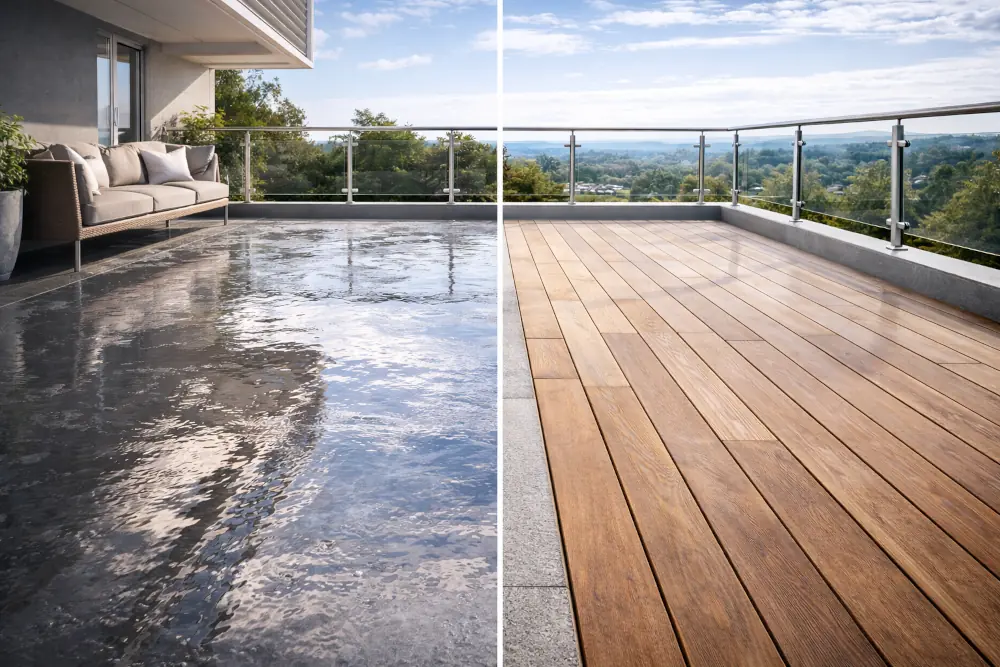
Deck & Balcony Waterproofing Auckland

Prevent costly damage with expert deck and balcony waterproofing that lasts.

Stop Leaks Before They Turn Into Structural Damage

An exposed deck or balcony in Auckland isn’t just another surface – it’s a critical barrier protecting your home or building.

With constant rain, humidity, and temperature changes, even a small weakness in waterproofing can quickly turn into:

  • Water leaking into interior spaces
  • Rotting timber framing
  • Concrete deterioration
  • Costly structural repairs

Dakom Tiling Services in Auckland, NZ

When waterproofing is done right, water drains away cleanly and the structure underneath stays protected for years. When it’s done wrong, water doesn’t stay on the surface – it finds a way in.

At Dakom Tiling, we specialise in deck and balcony waterproofing in Auckland, delivering systems that are built to last – not just pass inspection.

0+
HOME PROJECTS DONE
0+
BUSINESS PROJECTS DONE
0+
HAPPY CLIENTS
0hr
HOURS AVAILABLE

Why Most Deck & Balcony Waterproofing Fails

Waterproofing failures are rarely random – they happen for predictable reasons.

1. The Wrong System Was Used

Not all membranes are designed for exposed decks. Using interior or non-UV-rated products leads to cracking, breakdown, and early failure.

2. Poor Installation

Even high-quality systems fail when:

  • Membranes are applied too thinly
  • Cure times are rushed
  • Layers are incompatible

3. Junctions Were Not Done Properly

This is where most leaks start:

  • Wall-to-floor joins
  • Internal corners
  • Drain outlets
  • Penetrations (pipes, posts)
  • Movement joints

If these aren’t detailed correctly, water will eventually get through – guaranteed.

Why Auckland Makes Waterproofing Harder

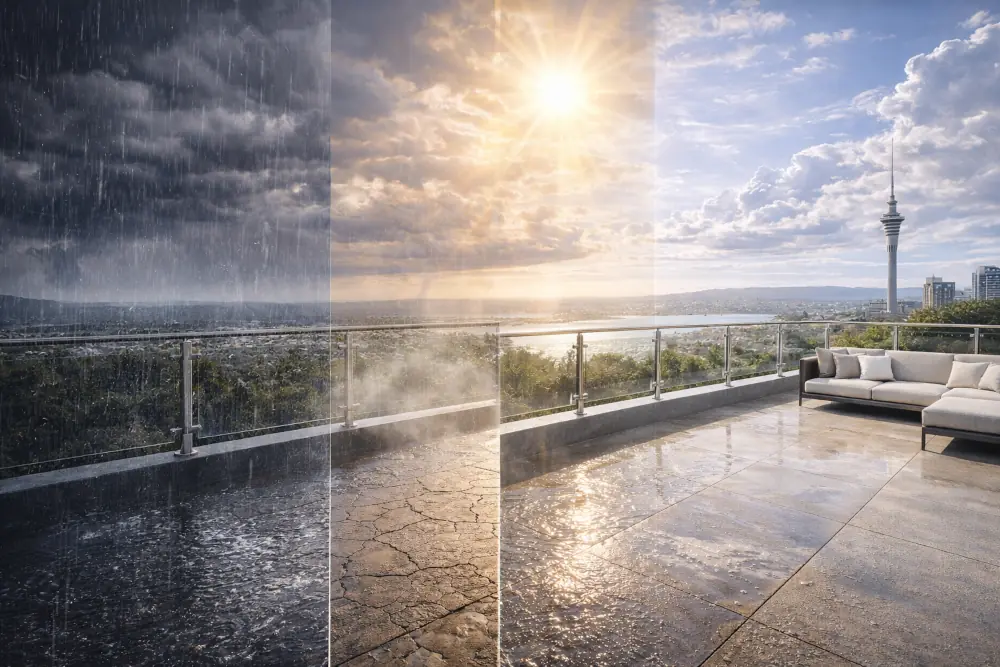
Auckland’s environment exposes weak waterproofing faster than almost anywhere else in New Zealand.

  • High rainfall – constant water exposure
  • UV radiation – breaks down inferior membranes
  • Thermal movement – expands and contracts substrates
  • Humidity – prevents proper drying

This means your waterproofing system must be:

  • Flexible
  • UV-stable
  • Fully sealed at all junctions
  • Designed specifically for exterior use

Anything less is a short-term fix.
dakom-tiling-bathroom-services-auckland

Timber vs Concrete Deck Waterproofing

Not all decks are treated the same – and they shouldn’t be.

Timber Decks

  • Require highly flexible membranes
  • Must handle movement and vibration
  • Critical to reinforce joints and fixings

Concrete Balconies

  • Focus on crack isolation
  • Proper fall and drainage are essential
  • Expansion joints must be respected

We tailor the system to the substrate – not force a one-size-fits-all solution.

Signs Your Deck or Balcony Is Already Failing

If you notice any of these, waterproofing may already be compromised:

  • Water stains on the ceilings below
  • Tiles lifting or cracking
  • Efflorescence (white powder residue)
  • Damp smells indoors
  • Visible cracks or bubbling

At this stage, it’s no longer preventative – it’s repair.

Dakom Tiling Banner

Deck & Balcony Waterproofing Auckland

Durable waterproofing for rain, UV, and movement.Prevent leaks before they turn into structural issues.

Get Your Free Quote

Why Should You Choose Dakom Tiling?

We ensure that streamlined processes are in place for our customers in order to provide great service and experience. Prompt communication and focus on above and beyond make us stand out from the rest.

4.9 Reviews on Builderscrack

We are proud to serve Auckland area customers and provide best tiling experience from start to finish. On Builderscrack our customers reviewed us with 4.9 stars across the board. For more information and detailed reviews click here to see our Builderscrack public profile.
Trusted Partners We Work With

We only work with trusted suppliers and materials so our customers can be sure they will have the best results from start to finish.


FAQs

Got questions? Here’s everything you need to know before hiring a tiler

In most cases, yes. Any deck or balcony that sits above an occupied space below – effectively acting as a roof to the room underneath – requires a waterproof membrane under the New Zealand Building Code clause E2 External Moisture, and waterproofing work on these surfaces almost always requires building consent. Changes to an existing membrane system, renovation of a deck that involves replacing waterproofing layers, or any work that alters the structure or drainage fall of the deck will also typically trigger a consent requirement. Like-for-like minor repairs may be exempt, but as soon as you are changing the membrane system, the drainage design, or the deck structure itself, consent is required. Auckland Council’s Practice Note AC2234 provides specific guidance on external membranes for decks and balconies. If you are unsure, checking with the Auckland Council or a certified waterproofing contractor before work begins avoids the costly consequences of unconsented building work.

This is one of the most common issues Auckland homeowners face, particularly in properties built during the 1990s housing boom, when waterproofing standards were poorly enforced. The most likely causes are a failed or degraded membrane, cracked or missing sealant at junctions where the deck meets the wall, blocked or inadequate drainage outlets causing water to pond on the surface, or tiles fixed directly over a membrane that cannot be inspected or maintained. The direction of water fall also matters – Auckland Council requires a minimum fall of 1:40 (approximately 1 degree) for deck membranes, and decks that have settled or were incorrectly formed may allow water to pool rather than drain. A waterproofing specialist will need to carry out a leak detection assessment to identify exactly where water is entering before any remedial work begins – attempting to patch the finish surface without finding the actual source is one of the most common reasons deck waterproofing repairs fail a second time.

Technically, yes, on concrete substrates, but the Auckland Council’s position is that direct fixing of tiles over membranes on timber-framed substrates is an alternative solution that requires specific justification and consent approval. The practical problem with tiling directly onto a membrane is that it makes the membrane impossible to inspect, maintain, or repair without removing all the tiles, which is expensive and disruptive. If the membrane fails at any joint or penetration, the leak is often not discovered until significant damage has already occurred to the structure below. For this reason, many waterproofing professionals in Auckland recommend a floating tile system on a pedestal or pad system over the membrane rather than direct fixing. This approach protects the membrane from foot traffic and UV degradation, allows water to drain freely, and enables access to the membrane for maintenance or repair without tile removal.

A professionally installed deck membrane system in Auckland should last between 10 and 25 years, depending on the system type, installation quality, and how well it is maintained. TPO and quality liquid-applied membranes at the higher end of that range, torch-on bituminous systems typically in the middle, and lower-quality systems or poorly detailed installations at the lower end. Auckland’s UV exposure, temperature fluctuations, and frequent rainfall all accelerate membrane degradation, particularly at junctions, flashings, and drainage points where movement and water concentration are greatest. Signs that a membrane needs attention include visible cracking, crazing, or blistering of the surface, sealant failure at wall junctions or around penetrations, water staining on the soffit or ceiling of the room below, ponding water that does not drain after rain, and efflorescence at edges or drainage points. Annual inspection – particularly after winter – is the most effective way to catch issues early before a failed membrane causes structural damage.

The right membrane depends on the deck construction type, substrate, drainage design, whether tiles or a trafficable surface will be applied over it, and the specific exposure conditions of the site. TPO single-ply membranes are increasingly popular for larger commercial and residential deck applications due to their heat-welded seams, UV resistance, and proven performance in New Zealand conditions. Liquid-applied systems such as Ardex WPM 300 are well suited to complex geometries, smaller areas, and repairs due to their seamless application. Torch-on two-layer bituminous systems remain widely used and perform well when correctly detailed and installed. PVC-based trafficable systems are a strong option where the deck surface will see regular foot traffic. In all cases, the membrane must be BRANZ-appraised or CodeMark-certified to demonstrate compliance with Building Code clause E2, and it must be installed by a contractor who is trained and certified by the membrane manufacturer – using an uncertified installer will void the product warranty and may result in the work failing council inspection.

Get A Quote Today

Let us know about your project, small or big, and we will make sure to make it for you.